---
title: "Bring back early 2000’s forum signatures"
description: "The nostalgia of a time long-lost to the internet at large."
date: 2026-06-22
updated: 2026-06-25
tags: ["nostalgia", "early-2000s", "smolnet", "indieweb", "web-revival"]
---
The early web was a riveting place back in the day. Every link clicked felt purposeful, every webring followed lead to dynamic personal encounters — more and more communities were being founded every single day. Forums used to be the go-to spot to find awesome things to discuss and hear about something new. Nowadays, it feels like there are sadly two or three “good” websites that garner enough attention (or dopamine) to keep someone on it for more than 6-10 minutes. The majority of that time is spent dodging ads or sifting through a soulless algorithm trying to relate to what a robot thinks you’ll enjoy.
Gone are the simpler times, where you’d stumble across a post from someone asking if anyone knows how to get around a cryptic obscure error code from a dying video game in 2003, or discussing what the latest Weezer album was like, and their post had these sick forum signatures attached to the footer of every post. People chiming in, coming and going -- creating this wall of animated gifs and callouts to inside jokes from their old AOL chatrooms or Xfire lobbies. Folks would band together around deploying certain signatures, forming off-shoot groups and sub-communities. I recall browsing various BBCode/phpBB forums were people were sharing basic HTML webpages focused around how to:
1. Learn the basics of HTML (in general)
2. Host various other forum signatures that you could download and share.
3. Render very limited sliders that could change hue colors/fonts and generate a right-click "savable" image that you could download.[^userbar]
[Userbars](https://www.userbars.org/), as I learned that they were called. You were cool if you had sick forum signatures in a nice, stacked arrangement. “**Nintendo Lover**”, “**Half-Life 2 Player**”, “**Napster User**”. They used to represent something more than the simple 300x24 banner image they were. I'm not sure if this is the nostalgia talking, but even as a crude form of identity, it created this sphere of _"this is my corner of the internet"_ type of vibe. Something I dearly miss in our modern website counterparts...
I remember starting conversations with strangers solely because I could see we shared the same interests in their signature/bio. Some folk, myself included, attribute an early beginning to graphic design to trying to make more of these signatures! They were _“hip”_ — everyone had one; creating them for others fed into that sense of community that was sort-of key to making new friends online. Not to mention the “glassy” trend that a majority of these signature banners were designed with attributes to this whole era of BBCode/Neocities forum-goers.
:::figure
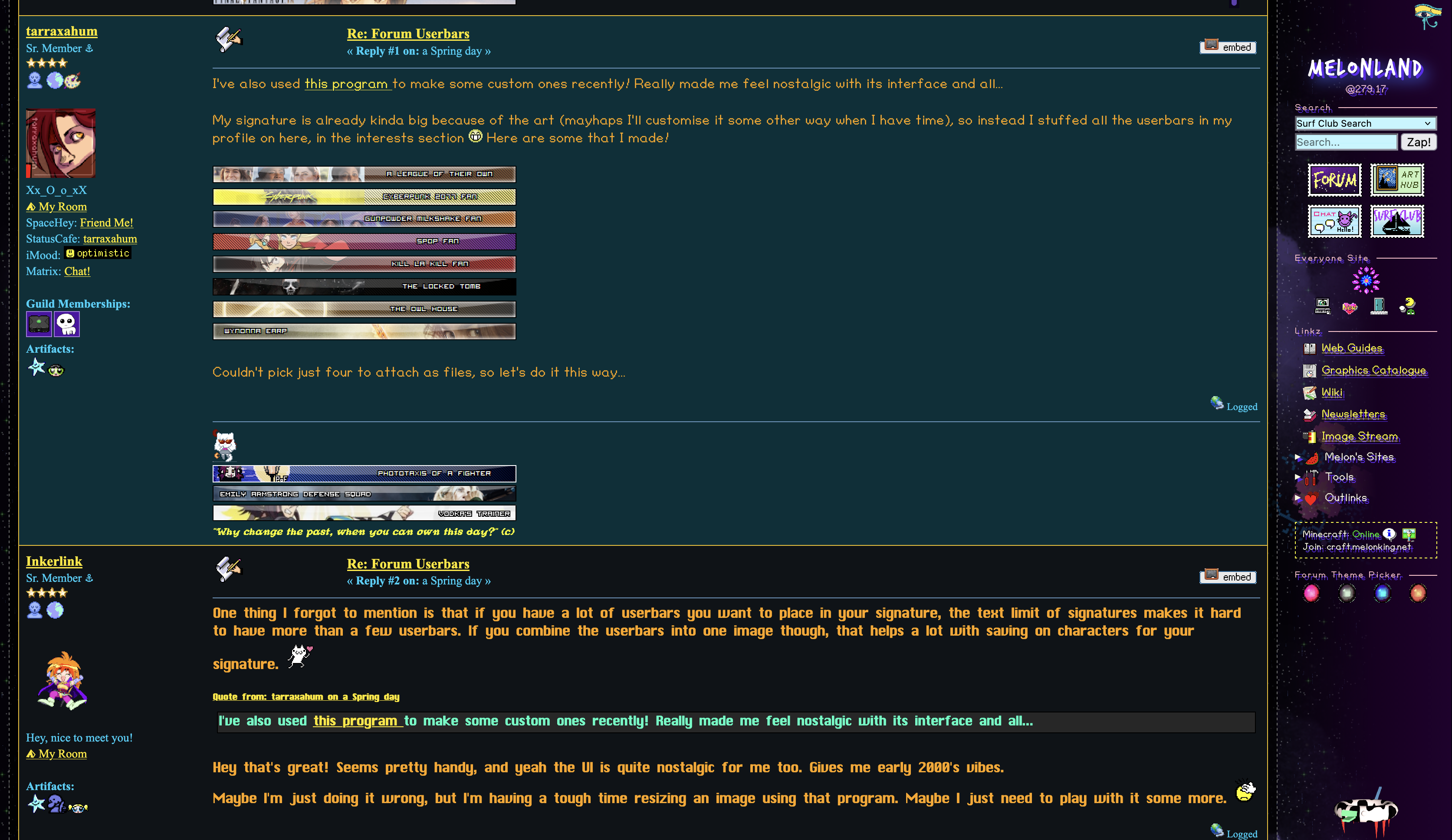
In my research, I've stumbled onto the amazing discovery of the [MelonLand Project](https://melonland.net/), a modern neocities-esque/retro web revival initiative, that has people actively featuring Userbars! Among various other very cool visual art projects across various mediums and forums (pictured above).
:::
Everyone online in today's age is a faceless, devoid string of characters being randomly assigned a profile handle and an AI-generated avatar. Not that previous iterations of forums weren't like this back in the day, but everything online feels so sterile...
## The Smolnet
I've been recently hopping on the `Indie Web` trend, as it seems a lot of people are nowadays.:sidenote[I am not stating this is a bad thing, per se, I am just worried about the potential future of an indie web becoming... well.. _not_ indie.] It's a double-edged sword, really -- the modern internet is the way it is, namely because of gross hyper-capitalism and an egregious sense of anti-privacy and oversaturation, so people want to shift towards something "smaller", more in-tune with how things used to be before ad-driven content and social media. So then it ends up bringing more people to these scenes, expanding these communities, causing a ruckus when things don't go the way people planned, splintering, etc. I've been been learning about other Indie Web adjacent things in the same vein, like [smolweb](https://smolweb.org/), [tilde.club](https://tilde.club), [bubbles.town](https://bubbles.town), and their associated protocols (Gopher, Gemini, Finger, etc.) Projects like [Gemini (Gemtext)]() catch my eye in most scenarios due to the idea of pointing the web in a direction of being simply Markdown renderers[^gemtext-md]. No CSS, definitely No JS, no tracking; **just** text, stylized to the absolute bare-minimum.
:::edit{date="2026-06-25"}
Since first publishing, and doing more deep dives into the world of smallweb/smolnet, I've discovered this awesome blog aggregator: [Kagi Small Web](https://kagi.com/smallweb), showcasing personal and individual blog authors based on a large variety of topics. Highly recommend!
:::
I think more care should be taken when considering something like a Smolnet protocol. I do see the want for something easier to manage and maintain, but it needs to not be able to balloon into something unsustainable in the near future. Many people online still claim to this day that we should return to XHTML. On a similar note, I've always liked the concept of [RFCs](https://en.wikipedia.org/wiki/Request_for_Comments) in this regard. To change something, you must first provide a documented reasoning for change, your proposed change, how this will impact future related protocols, etc. Seems like basic ITIL monotony but this leads to standardization.
Even as I'm writing this, it astonishes me that it took me this long to start to browse these sorts of communities. I've been loving reading your daily/general blog post from someone completely random online, similar to how one reads their newspaper in the morning with their coffee. Forget news orgs like Wired or Verge charging monthly subscriptions. I want to see what Lazer-Bunny is talking about on their Sanrio-themed HTML website formatted with `` elements.
If only there was a way to undo the damage the modern internet has caused, or contribute to helping the indie web get just a little bit bigger.
Bring back the community. Bring back that sense of whimsy and nostalgia; proclaim you are a Coca-Cola Drinker at the end of all your forum posts.

[^userbar]: I've went around and found this tool, [Userbar Generator](https://www.webestools.com/userbar-generator-free-online-tool-userbar-maker-photoshop-forum.html). A modern recreation of these older forum-sig-generator websites with updated HTML, used to archive nostalgia.
[^gemtext-md]: There is one small catch, it seems. Reading more about this online, specifically in HackerNews posts like [this one](https://news.ycombinator.com/item?id=36105625), Gemtext may not be the best suited for reviving the old internet, but I appreciate the waves it's trying to make. This blog post -- [Gemtext Is Not Accessible](https://aartaka.me/gmi-a11y.html) by [Artyom Bologov](https://aartaka.me/about.html) -- brings up the very important topic of A11y considerations when moving to something like a minimal text protocol meant to serve the general population simple information. (Expanding on this topic could be an entire series of blog posts on it's own!)