What's the Matter with content caching?
Brainstorming how to save articles for later, the proper and ethical way.
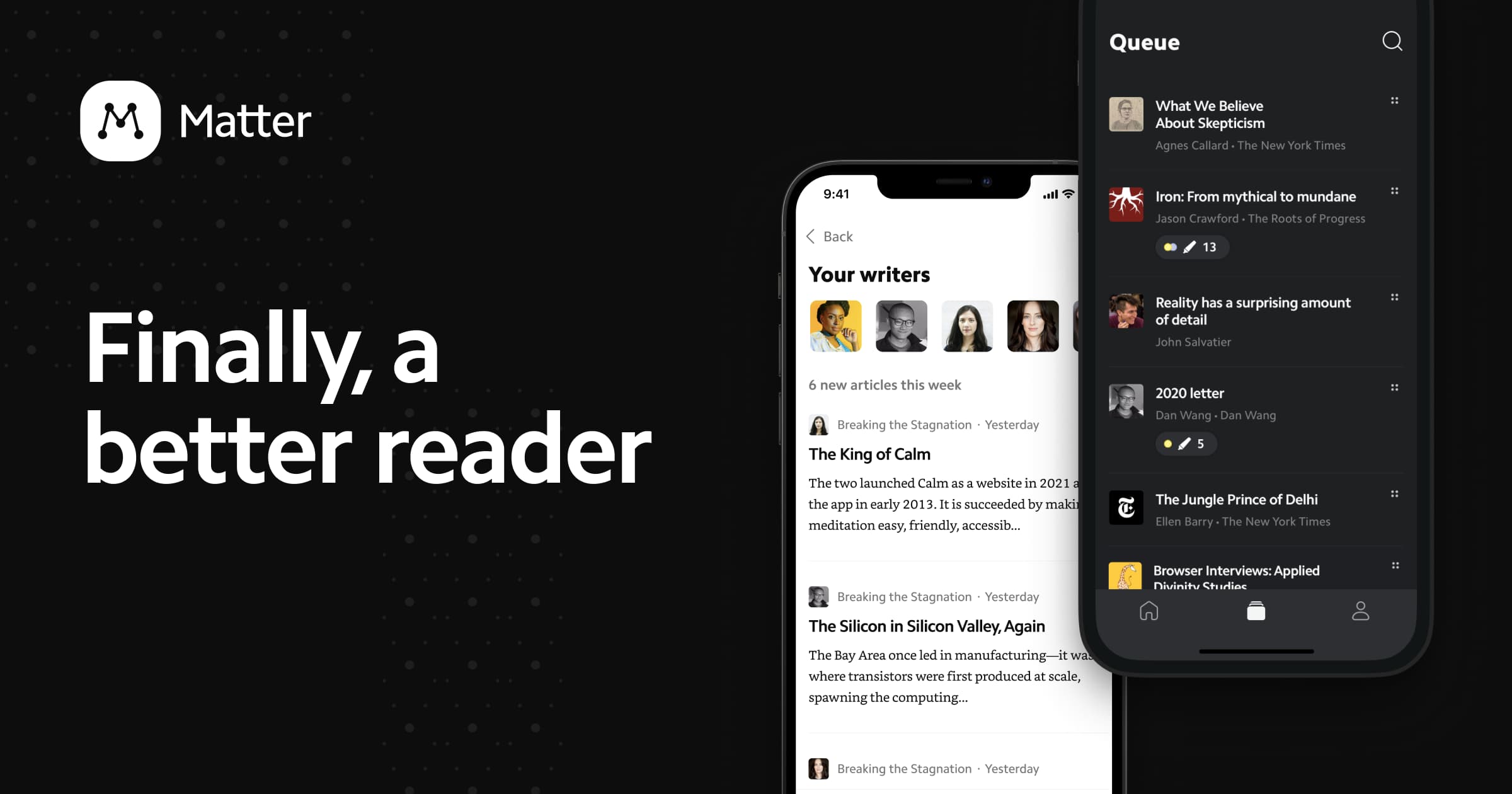
Finding good and interesting blog articles online really is a dream come true. Like anything on the internet, some days are just full of dull and repeatitive information dumps, but very rarely, when the bits and bytes align, you’ll find a gold mine worth of news/blog articles from niche/small creators. Sometimes I’ll spend hours just trying to add another 2 or 3 blog posts to my list of things to digest later.
I’ve been using Matter a lot over the past few weeks, and before I continue, let me just preface that this is not a post to shill this product or a listicle regarding the best pocket/reader-view app. Actually, this post should be quite the contrary. I really do enjoy having the ability to come back to an ever-growing list of amazing articles or posts, but a lot about the app is giving me the proverbial ‘ick’.
Namely: the amount of advertisments for their Pro-plan, pay-gating very simple features, the friction I experience when adding new articles to my collection, and my most hated design choice, not preserving/redirecting users to their original blog posts.1
Due to this, I’ve been churning in my head the idea of: what does it exactly take to have just a simple, straightforward, read-later application, that also cares about the people making the content, as well as the posts that they care so deeply about preserving?
Matter’s Features#
Since Matter has released on TestFlight as a beta back in early 2021, and based on the little historical research I can do regarding what features it did have versus didn’t/doesn’t have now, it appears that as of today (June 2026) Matter has had a handful of highlight features that it’s been panhandling to users for the last 5 years.
- Natural Text-to-Speech (TTS) (Pro Plan)
- Offline Search / Article Queuing
- Email Newsletter Management (Pro Plan)
- Writer/Blog/RSS Following (Pro Plan)
- Curated “More like this…” Content (Pro Plan)
Aside from the above, on their Matter Pro upgrade screen, the following are just a few of the things listed that upgrading to the Pro version gives you as well: Highlights & Annotations, Podcast & YouTube transcriptions, API & CLI access, etc.
On the topic of features + pain points, being notified constantly while just opening an app that, “You should spend some money and buy our Pro Plan!” to simply just READ something that SOMEONE ELSE created, absolutely grinds my gears. This probably wouldn’t make me irritated as much, if there wasn’t a permanent banner on my screen telling me to get X% off the annual subscription price. Hell, if it could make my app dumb, by taking away all the Pro features immediately, leaving me with the “free” version of the app, that would undo a lot of this article.
Their tagline, “Read with superpowers,” makes it seem like this should be doing somthing a lot more engaging and be chocked full of features, based on the eye-watering monthly subscription price of $12.99/mo for Matter Pro When publicly released (2023), Matter’s pricing was around $7.99/mo., which is still too high (imho), but it sincerely has me wondering if the new pricing is just to offset their dive into AI-related slop summaries and mid TTS features., which — for a simple read-later app — is actually kind of insane. I interpret this as Matter suggesting they have the same value as other paid apps, such as: Apple TV+, Spotify Premium, Kindle Unlimited (which is actually $11.99/mo), etc.
Unfortunately, It does not.
Matter-of-Fact#
In practice — and for what it’s worth — using Matter has been a really great experience. It’s UI is clean, it has very simple menus and buttons. It does exactly what it needs to do, which is: just save articles for later viewing. I would argue it’s “bonus” features are for caching text and image content locally on device so when you’re without internet, you can still sift through your backlog of articles. Every user (I imagine) utilizes Matter in different aspects.
As I’ve said above, my main goal for using this app was to find something that allowed me to come across very interesting and niche blog posts from authors across the internet and smolnet, and save them for later reading. Browsing websites like HackerNews, Bubbles.town, Brutalist.report, theindex.fyi I could truly keep going — aggregators like these nowadays are becoming my primary way of finding great authors., in any given 10 minute reading session, allows me to walk away with potentially up to 15-20 different posts that I truly find interesting, but just don’t have the time to follow up in that moment with reading them. The aggregators above have been a part of of my daily rotation for the past few weeks (with many more to follow, I’m sure), so I truly have been spoiled with the ability to find good, curated content.
As I was creating this personal website, and going through the mental motions of finding time to start writing again (it’s been many years at this point that I’ve chose to write for personal reasons), it somewhat dawned on me that I haven’t been doing my due dilligence when using Matter. I have around 30-40 different articles, at any given moment, that are waiting for me to view and engage with it’s content. At no time during all of these reads am I ever directed to the original blog-owner’s website… This just feels wrong to consume this content in this way. Authors spend a lot of time on their own websites, curating their own personal related content, and deserve the traffic and organic SEO!
Brainstorm Sesh#
What can we do about this? What should we do about this? Bookmarking and navigating directly to an author’s site would be preferable, but I really enjoy reading on the go, and I absolutely know there is a way to mesh all of this together. In my personal use case, the following would introduce the perfect alignment of read-later attributes, whilst embracing what the author originally intended:
- Ability to one-click store article/blog links in a single directory.
- Various date sorting methods, with default being: articles are sorted by Oldest -> Newest (descending) from date added to the app, so you can work on going through your collection, without skimming from just the top posts that were recently added.
- Tracking RSS/Atom/JSON article feeds should be a native (free) feature.
- When clicking on a blog/article post, if you are online (active Wi-Fi/cellular connection, simple ping test to another endpoint, hit an API on the app server for 200 response), you should be redirected to the author’s original link, to preserve traffic, analytics, design, SEO, etc.
- IF, you are NOT online, there are a couple of ways to go about this given the circumstances, and it should theoretically be based on what the author of the content authorizes, some ideas on this below:
These ideas are just simple brainstorm things, and may not work in practice — I’m just things throwing things out there. This also heavily relies on an honor system (perhaps a stated protocol?) that the application developed in question to resolve these issues will not bypass the implemented caching policy for any author. Unfortunately, there will always be some sort of script bot, LLM, website, app, etc., that would bybass these sorts of things or automate caching/scraping into oblivion. This is strictly for relating a general populace version of an ‘ethical’ caching system.
Conclusion#
There is a lot to think about regarding this, and I’ve already rambled on enough. Other addtional features would be easy to implement after this major design decision is made. Is this even worth it? Will there always be something thats redirecting user traffic? Is it worth to attempt to create a standard/app/protocol/honor system that will inevitably be circumvented? Is there already an app that does this based on our requirements and ethos we’ve stated above?
I may turn this into a series later on down the line, if I continue brainstorming this app idea, or perhaps readers would want me to continue. Could even work out a way to get this onto an actual App Store!
I just want to make sure, as an author and primarily as a reader, that paid-for applications and LLMs aren’t stealing analytics, visitors, organic traction, away from authors that deserve a notice or a follow!
Footnotes#
-
I understand one of the core premises of the application is regarding it’s offline-viewing capabilities, which helps others with spotty or little to no internet, out tremendously — but I strongly believe there are better, more “ethical” (lack of a better word) ways to go about offline article caching. (More information about this deeper in the post.) ↩